Lions rallied past 49ers on way to 1957 title
Posted: January 22, 2024 Filed under: football, NFL, Uncategorized | Tags: Bob St. Clair, Detroit Lions, Kezar Stadium, San Francisco 49ers, Tobin Rote, Tom "The Bomb" Tracy, YA Tittle 1 Comment
The year was 1957. Dwight Eisenhower was starting his second term as POTUS. Elvis Presley, hitting his stride, purchased Graceland. The USSR launched Sputnik, heralding the start of the Space Age. The Bridge on the River Kwai won the Oscar as best picture.
And the Detroit Lions won their fourth and final NFL Championship.
That year, the Lions had to go thru San Francisco to reach the title game. Detroit and the San Francisco 49ers each won their final three games that season to finish 8-4, tied for first in the NFL Western Conference. That necessitated a playoff game to determine which team would face the Cleveland Browns for the NFL Championship.
The teams squared off three days before Christmas at San Francisco’s Kezar Stadium to settle the Western Conference race.
The 49ers, whose founder and owner Tony Morabito suffered a fatal heart attack in a mid-season game against the Bears, took a 24-7 lead into halftime. Quarterback YA Tittle threw three touchdown passes in the first half, including a 34-yard “alley-oop” toss to RC Owens and a 47-yarder to Hugh McElhenny..
San Francisco, wh ich had already printed tickets for the championship game, entered the locker room in a jubilant mood, And when McElhenny ripped off a 71-yard run on the first play of the third quarter, the 49ers were set up deep in Detroit territory. The Lions defense stiffened, and limited the Niners to a field goal.
Trailing 27-7, Detroit rallied behind quarterback Tobin Rote, who was filling in for Bobby Layne, out with a broken ankle suffered in the next-to-last game of the regular season. Halfback Tom “The Bomb” Tracy, subbing for ailing running backs Howard :Hopalong” Cassady and John Henry Johnson, also had a big day.
Tracy scored on a one-yard plunge and a 58-yard run in the third quarter, and suddenly the Lions were within 27-21.
In the fourth quarter, Rote threw a 36-yard pass to Steve Junker to set up Gene Gedman’s 2-yard run. When Jim Martin kicked the extra point, the Lions took a 28-27 lead, their first of the game.
Martin’s 13-yard field goal provided insurance as the Lions advanced with a shocking 31-27 comeback victory.
The following week, the Lions routed the Cleveland Browns 59-14 at Briggs Stadium (later Tiger Stadium) to win their third NFL championship in six years. Rote threw for four touchdowns that day, two to Junker, and the Lions limited Cleveland rookie Jim Brown to 69 yards on the ground.
The Lions also won championships in 1935, 1952 and 1953. But they haven’t won since 1957. They did advance to one NFC Championship game – losing to the Washington Redskins 41-10 in 1992 – but have never made it to the Super Bowl.
The 49ers edged the Lions 24-23 in the 1983 divisional playoff round, the only other playoff meeting between the two teams.
NOTES: My former Daly City, California neighbor, offensive tackle and NFL Hall of Fame Bob St. Clair was a member of the 1957 49ers squad. St. Clair (#79 on your program) is pictured in the background in the photo at the top of this column.
A Giant comeback for the ages
Posted: September 18, 2023 Filed under: football, New York Giants, NFL, Uncategorized | Tags: Arnie Herber, Baltimore Colts, Chicago Cardinals, Daniel Jones, Eddie Price, Giant comebacks, New York Giants, Philadelphia 2 Comments
Saquon Barkley’s pilon lunge for a touchdown helps propel Giants rally in Arizona.
It took nearly three quarters of a century, but the Giants finally equaled the largest comeback in their 99-year history, rallying from 21 points down to defeat the Arizona Cardinals 31-28.
Turn the clocks back to October 30, 1949, at Comiskey Park in Chicago. That day the Giants trailed the Chicago Cardinals 28-7 at halftime, before launching a stirring comeback.
Jack Salscheider ran back the second half kickoff 95 yards for a touchdown that got the Giants rolling. They eventually took a 34-31 lead on Gene Roberts second TD, a one-yard run.
Then after the Cardinals regained the lead, Joe Scott plunged over from a yard out to secure the Giants 41-38 victory.
The G-Men, coached by Hall of Famer Steve Owens, would finish 6-6 that year, just behind the 6-5-1 Cardinals. Those Cardinals won their only NFL championship in 1947, and finished  runner-up to the Eagles in 1948. The team eventually moved to St. Louis in 1960 and then to Arizona.in 1988.
Another 21-point comeback
The Giants also engineered a 21-point comeback on December 2, 1945, against the Eagles at the Polo Grounds in Manhattan.
New York looked to be cooked when Steve Van Buren ran back the second half kickoff 98 yards for his third touchdown of the game to give Philadelphia a 21-0 lead.
But Giants quarterback and Hall of Famer Arnie Herber, right, threw three TD passes in the third quarter – all to Frank Liebel to tie the score.
And when Sam Fox caught a 5-yard pass from Herber late in the game, the Giants had an improbable 28-21 win. They finished the year 3-6-1.
The Giants have had several other amazing comeback through the years, though none larger than 20 points.
Rally against the Colts
In 1950, they trailed the Baltimore Colts 20-0 in the second quarter as YA Tittle, who later won an MVP with the Giants, threw a pair of touchdown passes. But Eddie Price rushed for a pair of TDs and QB Travis Tidwell threw two and scored another as the Giants scored 55 unanswered points for a 55-20 win at Memorial Stadium in Baltimore.
 The 1950 Giants wound up 10-2 before losing a playoff to the Cleveland Browns for the Eastern Conference title. The Colts finished 1-11.
In 1970, the Giants rallied from a 19-point deficit with three, fourth-quarter scores to beat the Washington Redskins 35-33 at Yankee Stadium. Running back Ron Johnson scored twice and Frank Tarkenton tossed a 57-yard touchdown to Tucker Frederickson to ensure the win.
In their Super Bowl championship campaign of 1986, the Giants twice came back from 17-0 deficits to beat the New Orleans Saints and later the San Francisco 49ers.
As recently as 2019, the Giants overcame an 18-point deficit to beat the Tampa Bay Bucs 32-31, Quarterback Daniel Jones, making his first career start and replacing Eli Manning, passed for two touchdowns and ran for two more, including a 7-run scamper with a little over a minute remaining to earn the win. The Giants trailed 28-10 at halftime.
The record for the biggest comeback in NFL history is held by the Minnesota Vikings. Last year, the Vikings overcame a 33-0, third quarter deficit to beat the Indianapolis Colts 39-36 in overtime.
Biggest comebacks in Giants history
Cashman strikes out with pitching disasters
Posted: August 15, 2023 Filed under: Baseball, MLB, New York Yankees, Uncategorized | Tags: Brian Cashman, Carlos Rodon, Frankie Montas, Jeff Weaver, Karl Pavano, Kei Igawa, New York Yankees, Pitching disasters, Sonny Gray Leave a comment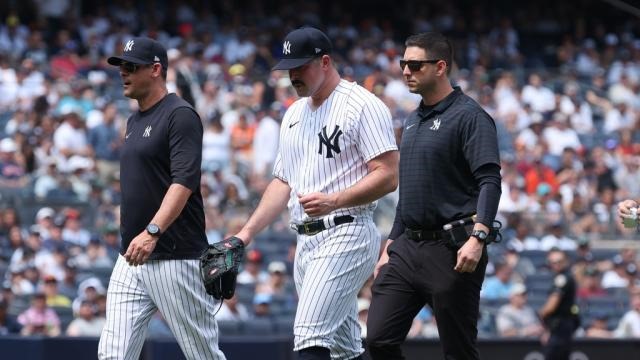
In addition to poor roster construction, bad drafts and a lousy farm system, Yankees GM Brian Cashman has struck out time and time again in his efforts to build a strong pitching staff.
Since Andy Pettitte made his debut in 1995, the Yankees have failed to produce a top-flight starting pitcher. So Cashman has banked on trades and free agent pickups to try and build a competitive mound corps.
Sure he’s landed some good ones, including Hall of Famer Mike Mussina, CC Sabathia and Gerrit Cole. But let’s face it, those were no brainers, easy acquisitions given New York’s financial war chest.
More often than not, however, Cashman’s pitching acquisitions have flamed out. The latest disaster is the oft-injured Carlos Rodon, shown above leaving the field after another injury, who the Yankees picked up in the off-season with a six-year, $162 payout. So far Rodon is 1-5 and..surprise, surprise…is currently on the IL once again.
Here, in chronological order, are 10 pitches who have flamed out during the Cashman regime, now 25 years and counting.
 Jeff Weaver – Leave it to Weaver to fail in New York. He was dealt to the Yankees as part of a three-team trade with the Tigers and A’s in July of 2002. In his two seasons with the Yankees Weaver, right, was a cumulative 12-12 with a 5.00 ERA. He’s remembered best for giving up a 12th inning, walk-off home run to Alex Gonzalez in Game 4 of the 2003 World Series that propelled the Marlins to an eventual six-game Series win.
Kevin Brown – Acquired from the Dodgers in 2003 for a package that included Jeff Weaver, Brown flamed out in New York. His underwhelming two-year mark of 14-13 with a 4.95 ERA was bad enough, but Kevin “Game Seven” Brown was the losing pitcher in the final game against the Red Sox in 2004, when Boston rallied from a 3-0 deficit to win the ALCS and break the “Curse of the Bambino.”
Javier Vazquez – Vazquez was initially traded to the Yankees by the Montreal Expos prior to the 2004 season. Compounding the problem, he was reacquired by New York from the Braves in 2009. His two-year record with the Yankees was 24-20 with a 5.09 ERA. He did win one playoff game, but had a post-season ERA over 9.00.
Karl Pavano – The American Idle was signed by New York for fours year and $38 million in 2004. The return – a 9-8 record and 5.00 ERA over years, most of which were spent on the disabled list.
Randy Johnson – Although he did win 17 games in each of his two seasons in the Bronx, Johnson was acquired in a trade with the Diamondbacks in 2005 to help the Yankees win the World Series. The Big Unit was a total disaster in his two playoff starts, routed by the Angels in 2005 and the Tigers in 2006 in a pair of ALDS failures. Two years later, he was shipped back to Arizona.
Kei Igawa – The Yankees acquired Igawa from the Hanshin Tigers of Japan in 2007 and gave him a princely five-year, $20 million contract. He won just two games with an overall 6.66 ERA, and was out of baseball a year later. Not exactly the type of production the Yankees were looking for.
Michael Pineda – The Yankees considered Pineda a stud starter when they acquired him in a trade with the Mariners in 2012. In four years in New York, he was a middling 31-31 with a 4.16 ERA.
 Sonny Gray – A success everywhere else, Sonny Gray couldn’t handle the New York stage. Acquired in a trading deadline deal with the A’s in 2017, his Yankee career line was 15 –16 with a 4.51 ERA. The Yankees sent Gray, right, to the Reds in 2019. He’s since made All-Star appearances with both Cincinnati and Minnesota.
J.A. Happ – The acclaimed Red Sox killer was traded to New York in 2018 by the Blue Jays, but failed miserably. He lasted just two innings in a 5-4 loss to Boston in Game One of the ALDS, as the Yanks were knocked out in four games. Following three vanilla seasons in New York, he was signed as a free agent by the Twins.
Frankie Montas – The Yankees acquired Montas in a trade with the A’s at the 2022 deadline. Montas was 1-3 in eight starts with the Yankees with a 6.30 ERA and gave up a home run in his lone inning pitching in the playoffs last year. Cashman knew Montas was an injury risk – he hasn’t thrown a single pitch this season.
Among his many flaws as a GM, Cashman seems to have a penchant for picking up pitchers with a injury histories. Rodon, who’s currently on the injured list for the second time this year, has made a career of begging hurt. Some describe Rodon as Frankie Montas disguised as a southpaw. .
Among other Cashman busts in recent years are Andrew Heaney, James Paxton, Jaime Garcia and Lance Lynn.
Despite these failures and more – the Yankees haven’t won a World Series since 2009 – Cashman can seem to do no wrong in the eyes of Hal Steinbrenner. And the beat goes on.
Winless in The Bronx: Yankees dominate Cubs
Posted: July 6, 2023 Filed under: Baseball, MLB, Uncategorized | Tags: Babe Ruth, Brett Gardner, Chicago Cubs, New York Yankees, Yankees vs Cubs rivalry Leave a comment
The Chicago Cubs visit The Bronx this weekend, still looking for their first win ever at Yankee Stadium.
The Yankees have beaten the Cubs all 12 times they’ve faced off at the Stadium, starting with the 1932 World Series. That year the Bronx Bombers defeated Chicago 12-6 and 5-2 in Games 1 and 2 of the World Series en route to a four-game sweep.
The photo above captures action during the 1932 World Series, before the mezzanine and upper deck in Yankee Stadium were extended to right field.
History repeated six years later, when the Yankees wrapped up another four-game sweep with 5-2 and 8-3 victories in Games 3 and 4.
Since interleague play began in 1997, the Yankees have continued their mastery of the Cubbies. A three-game sweep by New York in 2005 was highlighted by a Derek Jeter grand slam, pictured below, in the middle game. Amazingly, that was the only grand slammer Jeter hit in his illustrious Hall of Fame career.

In April of 2014, both Masahiro Tanaka and Michael Pinieda pitched shutouts as the Yankees took both ends of a doubleheader, 3-0 and 2-0.
And in their last meeting in The Bronx, one year ago, the Yankees won three straight by scores of 2-1 in 13 innings, 8-0 and 18-4.Talk about domination.
It doesn’t get much better for the Cubs in their Wrigley Field matchups with the Yankees, starting with two losses apiece in the 1932 and 1938 World Series. The highlight of those games was Babe Ruth’s called shot in Game 3, 1932, which sparked a 7-5 Yankee win.Ruth and Lou Gehrig each homered twice in the game.
The Cubs were coming off their first World Series victory in 108 years when the Yanks engineered a three-game sweep in 2017. Brett Gardner hit a three-run homer with two outs in the ninth to give the Yanks a 3-2 win in the first game of the series, New York then outlasted Chicago 5-4 in 18 innings in the finale of that series.
The Cubs took some solace by beating the Yankees two out of three at Wrigley in 2011. The Cubs also won one of three in 2011, and split a pair with New York n 2014.
So all told the Yankees are 23-4 vs. the Cubs, 12-0 at home and 11-4 on the road.
Florida on verge of hoop/hockey history
Posted: June 1, 2023 Filed under: Basketball, Hockey, NBA, NHL, Uncategorized | Tags: double titles, Florida Panthers, Florida sports, Miami Heat, NBA Championship, Stanley Cup Leave a comment
When Jimmy Butler, above, and the Miami Heat knocked out the Celtics earlier this week to derail a potentially devastating Boston comeback from a 3-0 deficit, they set up an unprecedented opportunity for South Florida sports.
Since the NBA was founded in 1946, five cities/areas have had teams in both the NBA and NHL finals in the same year. But none of those cities was able to finish the deal and win both a Stanley Cup and an NBA championship.
The Florida Panthers of the NHL are the other half of the two-step equation this year.after sweeping the Carolina Hurricanes in four straight games with the help of overtime hero Matthew Tkachuk, below, will face off against the Las Vegas Knights, each team seeking its first Stanley Cup.
Meanwhile the Heat, the eighth seed in the East, will meet the Denver Nuggets for the NBA championship. The Heat have won three NBA crowns – in 2006, 2012 and 2013. This marks Denver’s first trip to the finals.
Other finalists
And it marks the 10th time overall that a city has had teams in both the NBA Finals and Stanley Cup. Boston (3). New York (2), Philadelphia, Chicago, New Jersey and the San Francisco Bay Area have come close, but none has experienced dual championships.
In both 1957 and 1958, the Celtics and Bruins played for championships for the city of Boston. In 1957, the Celtics won their NBA championship when they beat the St. Louis Hawks in seven games.The following year the Celtics lost to St. Louis in six games.
 The Bruins meanwhile, lost both Stanley Cup finals to the Montreal Canadiens, in five games in 1957 and six games in 1958. The Canadiens were in the midst of a five-year championship run.
In 1972, both the Knicks and Rangers made their respective finals. That year the Lakers defeated in the Knicks in five games for the NBA crown, and Boston defeated New York in six games for the Stanley Cup.
Two years later, in 1974, the Celtics beat the Milwaukee Bucks in seven games, but the Philadelphia Flyers surprised the Bruins in six games to win their first Stanley Cup.
Philly faves
The City of Brotherly Love was a two-time loser in 1980 — the 76ers lost to rookie point guard Magic Johnson and the Lakers in six games while the New York Islanders took the Flyers in six games for the first of four straight Stanley Cups.
In 1992, Michael Jordan and the Chicago Bulls beat the Portland Trailblazers in six games, but the Blackhawks were swept by the Pittsburgh Penguins in the Stanley Cup finals.
New York came closest to winning double rings in 1994. That year the Rangers beat Vancouver in seven games to win their first Stanley Cup in 54 years. But the Knicks fell to the Houston Rockets in another seven-game series.
In 2003, the New Jersey Devils beat the Anaheim Ducks in seven games to win the Stanley Cup, while the New Jersey Nets lost to the San Antonio Spurs in six games.
Finally, in 2013, the San Francisco Bay Area experienced a double. The Golden State Warriors lost to the Cleveland Cavaliers in seven games, and the San Jose Sharks succumbed to the Pittsburgh Penguins in six.
Yankee team that Cashman built is sinking fast
Posted: April 29, 2023 Filed under: Baseball, New York Yankees, Uncategorized | Tags: Aaron Boone, Aaron Judge, Brian Cashman, Carlos Rodon, Frankie Montas, Giancarlo Stanton, Josh Donaldson, Yankees, Yankees trending down 2 CommentsOn the night of July 8, 2022, the Yankees routed the Red Sox 12-5 at Fenway Park to extend their record to 61-23, the best in baseball at that point.
The following night the Yankees blew a lead and lost an extra inning game to the Boston. They finished out the season 38-40 over the final 78 games. Although the Yankees did wind up with 99 wins and the AL East title, they floundered down the stretch.
The team that Brian Cashman built is 53-52 over the past four months, including 15-12 so far this season. If you count their 2022 playoff record (they beat Cleveland 3-2 before being swept by Houston) the Yankees are below .500 at 56=58.
That’s not good….it’s not even acceptable. It’s terrible
You be the Judge: Yankees trending down
This is the team that Cashman built. And it appears to be trending down, especially if the Yanks lose Aaron Judge for any length of time. Judge suffered a hip injury on a headfirst slide trying to steal third base with a 5-0 lead. Judge went in for an MRI yesterday. Not a good sign.
Several weeks ago the Yankees lost the other half of their dynamic slugging duo. The porcelain doll known as Giancarlo Stanton pulled a hamstring when he raced into second base after admiring a ball he thought was going to be a home run. Stanton is out another month at least.
And centerfielder Harrison Bader has yet to play an inning this year after injuring his oblique muscle in spring training.
 These injuries have left the outfield in a quandary. Oswaldo Carbrera, Franchy Cordero, Ian Kiner-Falefa and Aaron Hicks, the most despised Yankee of all, have been forced into the lineup. Only Cabrera is batting over. 200….just barely.
There’s more problems in the infield on the team that Cashman built. The injured Josh Donaldson is a deadweight, a shell of his former self. The Yankees can’t dump him because of his near $30 million paycheck, including buyout.
The bottom of the lineup looks more like the 1968 Yankees…..who hit .214 as a team.
Pitching woes continue
Going into the 2023 season, the Yankees seemed to boast one of the best pitching staffs in the majors. But that staff has been decimated by injuries.
Heralded free-agent acquisition Carlos Rodon, Luis Severino, and Frankie Montas have yet to throw a pitch this season. Cashman gambled on guys with injury histories, and he’s been burned.
As a result, the Yankees have relied on Jhony Brito, Domingo German and Clarke Schmidt, guys who hardly qualify has major-league starters.
And the bullpen has been hampered by injuries to Tommy Kahnle, Jonathan Loaisiga and others.
It’s fashionable to knock Yankee manager Aaron Boone – and there’s plenty to knock. His handling of the bullpen, his propensity to sit hot hitters, his overly optimistic outlook.
But at the end of the day, the finger points at Cashman. He’s been around for 25 years, and last winter signed a four-year contract extension. But perhaps it’s time to find some some new blood, some different ideas.
After all, this is the team that Cashman built.
It’s not a true Fourth without Yankee baseball
Posted: July 4, 2022 Filed under: 1961 Yankees, Baseball, MLB, Uncategorized, Yankees | Tags: Dave Righetti, Fourth of July, Lou Gehrig, Mike Mussina, Roger Maris, Yankees Fourth of July Leave a comment
Baseball on the Fourth of July, is as American as baseball, hot dogs, apple pie and Chevrolet.
Well not so much for the Yankees. Not this year. For some unfathomable reason, MLB has scheduled an off day for the Yankees on the Fourth – the traditional midpoint of the season.
The Yankees have made Fourth of July history on many occasions. For instance:
July 4, 1939 – Between games of a doubleheader with the Washington Senators, Lou Gehrig delivered his “Luckiest man on the face of the Earth” speech. The crowd of 61,808, many in tears, listened as Gehrig, dying from ALS, the disease that today bears his name, delivered baseball’s equivalent of the Gettysburg Address. Oh yes, the Senators won the opener, 3-2. The Yankees rebounded to rout Washington 11-1 in the second game.
July 4, 1961 – More than 74,246 fans packed the Stadium to witness a doubleheader with the Detroit Tigers. The great home run chase, with Roger Maris and Mickey Mantle both on pace to better Babe Ruth’s 60, took center stage. Maris homered in the second game, his 31st HR of the season, tying the game in the eighth inning with a two-run shot to right. Mantle was held homerless that day. The Yankees won the open er 6-1 behind Whitey Ford. The Tigers took the nightcap 4-3 in 11 innings.
July 4, 1983 – In celebration of George Steinbrenner’s birthday, young Yankee left-hander Dave Righetti pitched a no-hitter against the Red Sox as the Yanks beat their rivals 4-0. Righetti struck out future Yankee and Hall of Famer Wade Boggs for the final out. It was the Yankees first no-hitter since Don Larsen pitched a perfect game against the Brooklyn Dodgers in the 1956 World Series.
PERSONAL NOTES: I saw the Yankees play twice on the 4th, once at the original Yankee Stadium and the other time at the renovated ballpark.
July 4, 1973 — Fresh out of college and living in Holden, Mass., I traveled with a bunch of my Holy Cross colleagues to the Bronx to catch a doubleheader with the Red Sox. The Yankees, behind Mel Stottlemyre and a Bobby Murcer home run, led 1-0 entering the ninth inning of game one.. But the Red Sox rallied for a pair of unearned runs against Sparky Lyle to win, 2-1. In the nightcap, Roger Moret outdueled Doc Medich and 1-0. Carl Yastrzemski singled in the only run of the game.
July 4, 2002 – On a hot, steamy afternoon in the Bronx, I accompanied my son, brother-in-law and nephew to a game with the Cleveland Indians (now Guardians, to be politically correct). Raul Mondesi and Jason Giambi homered in support of Mike Mussina in a 7-1 Yankee win.
No history this year for the Yankees. No game on the Fourth of July.
SportsLifer Flashback: 1061 Yankees
Thanks Hal: Yankees sell out to Amazon Prime
Posted: May 28, 2022 Filed under: Baseball, MLB, Uncategorized | Tags: Amazon Prime, Hal Steinbrenner, New York Yankees, Phil Mushnick, Yankees TV 2 CommentsAs if the Yankees don’t make enough money already, they have sold the broadcast rights to 21 games this season to Amazon Prime and its streaming service.
Thanks Hal. Steinbrenner cares more about the pinstripe bottom line than loyal Yankee fans who will be missing out on a full one-eighth of the team’s schedule if they don’t pay a premium rate to Amazon.
 In a surprise exclusive move, Amazon bought out the Yankees Channel 11 package in what New York Post columnist Phil Mushnick calls “the viewing equivalent of making the best seats in ‘new’ Yankee Stadium unaffordable, thus annually empty.”
Obviously, many Yankee fans who rely on network TV and can’t afford a premium package are now shut out, unable to see their Bronx Bombers.
There’s no more Friday night baseball for Yankee fans, since the Amazon Prime games fill out the Friday schedule. And on the rare occasions when Prime isn’t airing, Apple +, another pay streaming service, has picked up the remaining games.
To add salt to the wound, the Amazon Prime Yankee games are not shown on the MLB Network in the New York area, although they are carried on MLB in the rest of the country.
As Mushnick notes, “The greatest-good Channel 11 days have been sold at auction, the Yanks self-regulated to ‘“Consult local listings’ vagabonds.”
80-1 shot Rich Strike wins Kentucky Derby
Posted: May 21, 2022 Filed under: Uncategorized | Tags: Country House, Donerail, Giacomo, Kentucky Derby, Kentucky Derby biggest upsets, Rich Strike Leave a comment
In May of 1913, Woodrow Wilson was beginning his first term as President. The seeds for WWI were already planted Europe.The 16th Amendment made it clear that we’d all pay income taxes. The Woolworth Building, at that time the tallest building in the world, opens in New York City.
That year, Donerail, a 91-1 shot, won the Kentucky Derby. It took 108 years to come close to that big an upset, until Rich Strike came from the back of the pack but made a pass down the stretch, passing 16 horses to win, at 80-1.Rich Strike paid $163.60 to win. Only Donerail paid more at $184.90. With inflation a $2 bet to win would be worth $5,480.36 today.
Ironically, the next three biggest Kentucky Derby upsets all occurred in the last 13 years. In 2019, Country Horse won at 65-1. Both Mine That Bird (2009) and Giacomo (2013) won against 50-1 odds. Country House finished second in the race but was later was moved up to first after the stewards at Churchill Downs disqualified first-place finisher Maximum Security for interference.
Rich Strike wasn’t even in the Derby until the day before the race, when Ethereal Road was scratched. That made room for the chestnut colt, who had two previous wins in his career.
Mel Stottlemyre’s inside-the-park grand slam
Posted: May 17, 2022 Filed under: Baseball, MLB, Uncategorized | Tags: Babe Rurh, Bob Tillman, Hank Aaron, Honus Wagner, Mel Stottlemyre, Michael A. Taylor, Roberto Clemente Leave a comment
Some of the old timers out there might remember when Mel Stottlemyre hit an inside-the-park grand slam against the Red Sox at Yankee Stadium.
The date was July 20, 1965, and I recall listening to the call on the radio on the beach in Spring Lake, New Jersey. The grand slam, which came in the fifth inning, helped the Yankees to a 6-3 win over Boston that day as Stottlemyre recovered from his race around the bases to hurl a complete game.
With Yankees leading 2-1 in the fifth on a two-run homer by Tony Kubek, the Yankees loaded the bases on a walk to Joe Pepitone, a single by Clete Boyer, and another walk to Roger Repoz.
 Stottlemyre then lined a pitch up the left-center field alley between Red Sox left fielder Carl Yastrzemski and center fielder Jim Gosger and just beat the relay home for one of the most improbable grand slams in baseball history.
“I remember a lot about it,” Stottlemyre, pictured left, said. “It was in the [Yankee] stadium, the ball was hit to left-center field, against Boston, a real hot day in July. The pitcher was Bill Monbouquette. Those things you don’t forget.”
Stottlemyre spent his entire 11-year career with Yankees before injury forced him to retire in 1974. He had a 164-139 record with a 2.97 ERA and 40 shutouts in his career. He won 20 games in 1965, 1968 and 1969. He was a long-time pitching coach with both the Yankees and the Mets.
Stottlemyre had seven home runs in his career. The inside-the-park grand slam was his second career home run.
I did not realize until recently exactly how rare an inside-the-park grand slam really is. For instance, Stottlemyre become the first pitcher to hit an inside-the-park grand slam since Deacon Phillippe did it for the Pirates in 1910. No pitcher has done it since. And with the universal DH, no pitcher may ever do it again. (Although I wouldn’t count out Shohei Ohtani.)
Inside-the-park home runs were much more common in the first half of the century, when ballparks were bigger and there was less emphasis on hitting the ball over the fence. There have been 224 inside-the-park grand slams dating back to the 19th Century, but less than 50 since 1950.
The last was in September 2017, when a Phillies outfielder badly misplayed a hit allowing Michael A. Taylor of the Washington Nationals and three of his teammates raced around the bases to score.
EDITORS NOTE: I first posted this blog nearly 14 years ago, only July 11, 2008. Since then I have received nearly 100 comments from fans who were at the game, remembered the feat or were simply amazed the play ever happened. I’ve never been able to find any video the play. Not even sure it was televised. Just today, I came across the only known photo of the Stottlemyre grand slam, which I’ve included above.
Umpire Nestor Chylak is giving the safe call as Stottlemyre slides across home plate past Boston catcher Bob Tillman. Yankees Joe Pepitone (25) Bobby Richardson (1) and Roger Repoz look on. The Yankee on the left presumably Clete Boyer, who scored on the home run along with Pepitone and Repoz.
 SportsLifer's Weblog